Choosing among the Top 10 Hand Held Rock Drills requires more than comparing impact rates and catalogue prices. Global buyers face different rock formations, climates, power systems, service networks, and jobsite expectations. A drill that performs smoothly in hard granite may feel excessive in softer limestone. Another model may appear efficient, yet demand frequent hose repairs in dusty conditions.
Mining engineer Dr. Alan M. Hustrulid has stressed a practical principle: “The best drilling method must match the rock, the equipment, and the people using it.” This idea remains valuable when evaluating Hand Held Rock Drills. Buyers should examine drilling speed, tool weight, vibration control, air consumption, water flushing, and available replacement parts. Operator comfort matters too. A heavy drill can reduce productivity after several hours, even when its headline power looks impressive.
This guide compares ten widely considered models through a buyer-focused lens. It considers field usability, manufacturer support, durability, maintenance access, and performance evidence. Specifications alone can mislead. Some published figures come from controlled tests, not muddy tunnels or uneven quarry benches. Real work is less tidy.
The ranking is therefore useful, but not absolute. Local geology may change the result. So can operator skill, compressor quality, and spare-part access. Each selection includes practical strengths and possible weaknesses, helping contractors, distributors, and project managers make more defensible purchasing decisions. A small compromise may still be the right decision. Reliability often beats impressive numbers.
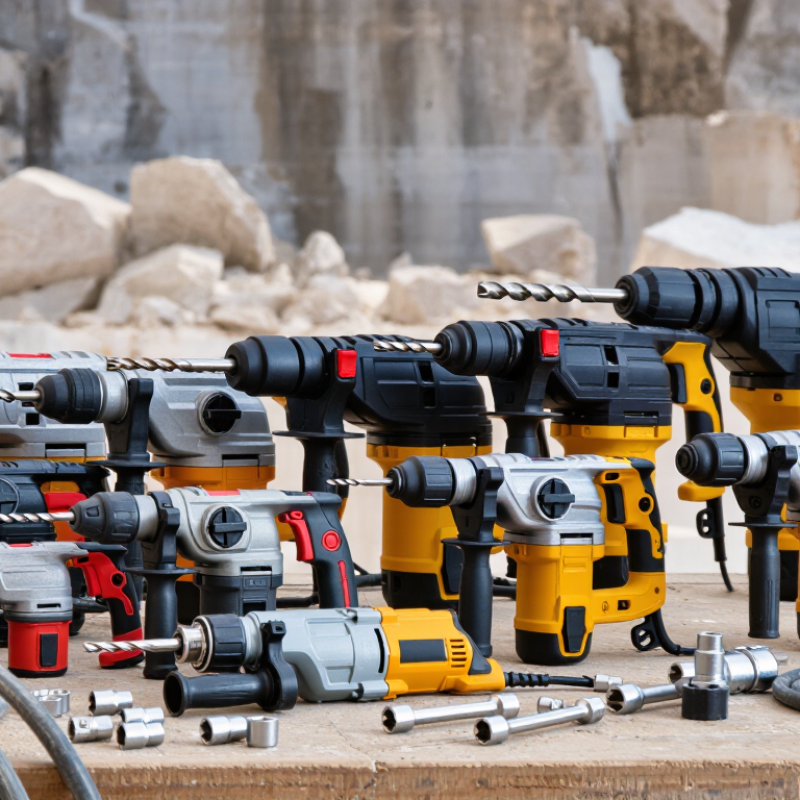
Handheld rock drills use compressed air or hydraulic power to turn pressure into impact energy. A piston repeatedly strikes the drill steel, while a rotating mechanism keeps the bit cutting fresh rock. Air or water then flushes dust and fragments from the hole. The operator feels every cycle through the handles.
For global buyers comparing the top ten handheld rock drills, working conditions matter more than advertised impact power. Pneumatic models suit quarries and construction sites with reliable compressors. Hydraulic models can deliver strong output from compact power packs, but hoses require careful inspection. Weight also changes productivity. A 20-kilogram drill may penetrate quickly, yet it can exhaust one operator during repeated overhead work. That assumption can fail.
Vibration deserves measured attention. The UK Health and Safety Executive sets an exposure action value of 2.5 m/s² A(8) and a limit value of 5 m/s² A(8) for hand-arm vibration. These figures come from its hand-arm vibration guidance. CDC/NIOSH research also links repeated vibration exposure with reduced grip strength, numbness, and circulation problems. Buyers should request measured vibration values, not rely only on marketing language. Check the trigger, muffler, hose connection, and lubrication system on site. Listen for uneven piston impact. Small leaks become large losses. A quieter drill is not automatically safer, and published figures may change with rock hardness, bit condition, and operator technique. The best selection combines penetration rate, service access, noise control, vibration exposure, and local technical support.
Top 10 Hand Held Rock Drills for Global Buyers
Essential Specifications for Comparing Rock Drill Models
Comparing ten hand held rock drills requires more than reading impact energy figures. Check the recommended hole diameter, drilling depth, rotation speed, and air consumption. These specifications show whether a tool fits granite, concrete, or softer stone. A drill producing strong impacts may still perform poorly with an undersized compressor.
Weight matters on real worksites. A 25-kilogram tool can feel manageable for short holes, then become exhausting during a full shift. Examine vibration levels, handle design, balance, and noise data. Confirm the shank size and hose connection before ordering. Small mismatches can delay production and create unsafe improvisations.
I once valued impact power too highly. Field use changed my view. A slightly lighter drill with stable rotation often delivered better daily output. Ask suppliers for test conditions, not only peak figures. Compare air pressure, bit type, rock hardness, and operating time. Manufacturer data is useful, but operator feedback reveals maintenance problems and control issues. Check lubrication needs, spare-part availability, corrosion protection, and service instructions. Regional conditions also matter, especially dusty sites and unstable power supplies. No specification is perfect. Some published vibration figures may not reflect older equipment or poorly maintained hoses. A careful buyer should record trial results before making a large purchase.
Choosing a handheld rock drill depends on the work condition, not only impact energy. The U.S. Geological Survey’s Mineral Commodity Summaries 2025 estimated U.S. crushed-stone production at about 1.5 billion metric tons in 2024. That scale demands reliable tools for quarry faces, road cuts, and aggregate sites.
For dry quarry work, choose a pneumatic drill with strong air filtration and a visible dust-control connection. OSHA limits respirable crystalline silica to 50 micrograms per cubic meter over eight hours. Wet drilling helps, but muddy platforms can increase slipping risks. Underground crews need compact drills, short hoses, and angled handles for narrow headings. In high-altitude locations, reduced air density can weaken pneumatic performance. Allow extra compressor capacity.
For remote construction, battery or hydraulic models reduce hose management. However, battery runtime drops in cold conditions. This detail is often missed. UK HSE guidance sets the hand-arm vibration action value at 2.5 m/s² A(8), with a 5.0 m/s² exposure limit. Buyers should compare measured vibration, not marketing labels. A lighter drill may reduce fatigue, yet it can struggle against fractured granite. That trade-off needs a site trial. For wet tunnels, inspect insulation, seals, and drainage before purchase. For surface scaling, prioritize balance and controllable impact over maximum power. Our selection can still be imperfect when rock hardness changes within a single bench.
| Rank | Handheld Drill Type | Best Work Condition | Typical Rock or Task | Recommended Drilling Diameter | Typical Drilling Depth | Working Air Pressure | Air Consumption | Impact Frequency | Approx. Weight | Main Advantage |
|---|---|---|---|---|---|---|---|---|---|---|
| 1 | Light-Duty Jackleg Drill | Underground headings, small mining faces, and general construction | Soft to medium-hard rock, concrete, and masonry | 22–40 mm | Up to 3 m with extension steels | 5.0–6.3 bar | 2.5–3.5 m³/min | 2,000–2,500 blows/min | 24–30 kg | Balanced portability, drilling speed, and operator control |
| 2 | Heavy-Duty Jackleg Drill | Hard-rock mining and long shifts in underground operations | Hard granite, basalt, quartzite, and competent ore | 28–45 mm | Up to 4 m with suitable steels | 5.5–6.3 bar | 3.0–4.5 m³/min | 1,900–2,300 blows/min | 30–38 kg | Higher impact energy and durability for demanding rock |
| 3 | Sinking Drill | Vertical or inclined holes in shafts, foundations, and confined areas | Concrete, limestone, sandstone, and medium-hard rock | 25–45 mm | 1.5–3 m per drilling cycle | 5.0–6.3 bar | 2.5–4.0 m³/min | 1,800–2,400 blows/min | 25–36 kg | Designed for controlled feed and stable hole alignment |
| 4 | Water-Flushing Rock Drill | Dust-sensitive mines, tunnels, and enclosed construction sites | Hard rock where airborne silica dust must be reduced | 25–42 mm | Up to 3 m with extension rods | 5.0–6.3 bar | 2.5–4.0 m³/min | 1,900–2,400 blows/min | 26–35 kg | Water flushing improves hole cleaning and suppresses dust |
| 5 | Pusher-Leg Drill | Overhead drilling, roof bolting, and upward or angled holes | Medium-hard to hard rock in underground workings | 28–45 mm | Up to 3.5 m with extension steels | 5.5–6.3 bar | 3.0–4.5 m³/min | 1,900–2,300 blows/min | 32–42 kg including support leg | Adjustable thrust assists overhead and angled drilling |
| 6 | Low-Noise Pneumatic Rock Drill | Urban maintenance, utility work, and noise-controlled locations | Concrete, brickwork, limestone, and moderately hard rock | 20–38 mm | Up to 2.5 m | 5.0–6.0 bar | 2.0–3.2 m³/min | 1,700–2,200 blows/min | 20–28 kg | Reduced exhaust noise and improved suitability for populated areas |
| 7 | Compact Handheld Drill | Remote maintenance, quarry trimming, and limited-access work | Soft rock, weathered rock, block stone, and masonry | 18–32 mm | Up to 2 m | 4.5–6.0 bar | 1.8–2.8 m³/min | 1,800–2,500 blows/min | 16–24 kg | Easy transport and reduced operator fatigue |
| 8 | High-Impact Drifter-Style Hand Drill | Fast drilling in hard rock where productivity is prioritized | Granite, basalt, hard limestone, and dense ore | 30–50 mm | Up to 3 m with compatible rods | 5.5–7.0 bar | 3.5–5.5 m³/min | 1,600–2,100 blows/min | 35–50 kg | High impact energy for rapid penetration in competent rock |
| 9 | Gasoline-Hydraulic Handheld Drill | Remote sites without compressed-air or electrical infrastructure | Natural stone, concrete, and medium-hard rock | 20–40 mm | Up to 2.5 m | Not required | Fuel consumption typically 0.8–1.5 L/h | 1,500–2,200 blows/min | 25–38 kg | Independent operation where compressors are unavailable |
| 10 | Electric Rotary-Hammer Drill | Indoor construction, utility installation, and intermittent drilling | Concrete, brick, block, and soft to medium rock | 16–40 mm | Up to 1.5 m per hole | Not required | 1.0–2.5 kW electrical input | 1,500–3,500 blows/min | 8–18 kg | Lower setup requirements and precise control for short holes |
Choosing among the top 10 hand held rock drills requires more than impact energy and drilling speed. Global buyers should examine vibration, noise, dust control, guarding, and operator training. The European Agency for Safety and Health at Work identifies hand-arm vibration as a major occupational risk. Under EU Directive 2002/44/EC, the daily action value is 2.5 m/s² A(8), while the exposure limit is 5.0 m/s² A(8). These figures should guide product comparisons.
Safety begins with the operator. Workers need practical instruction on secure footing, hose inspection, bit changes, and emergency shutdowns. A drill can shift suddenly when the bit meets fractured rock. That moment tests training. The International Labour Organization estimated 2.93 million work-related deaths globally in 2019, showing why safety systems cannot rely on experience alone. Maintenance also matters. Inspect couplings, lubricate moving parts, clean air passages, and replace damaged handles before each shift. Poor lubrication increases heat, wear, and unexpected downtime.
Tips: Record vibration exposure by task, not just by machine. Rotate operators only when exposure records support the decision. Provide hearing protection, eye protection, gloves, respiratory protection, and safety footwear based on site risks. Keep dust suppression equipment functional. It is often neglected. Supervisors should review maintenance logs weekly and compare actual performance with the manufacturer’s technical data. Buyers should request independent vibration and noise test results, because catalog values may not reflect fractured rock, worn bits, or uneven ground. A realistic trial is still essential.
Selecting a hand held rock drill begins with the worksite, not the catalogue. Define the rock hardness, hole diameter, drilling depth, and daily operating hours. A drill for short anchoring holes may fail during continuous quarry work. Weight matters too. A 12-kilogram tool can feel manageable at first, then strain an operator after several hours.
Compare pneumatic, hydraulic, and electric options against available power. Check air pressure, air consumption, torque, impact rate, and vibration levels. Request test records, material specifications, and maintenance instructions from the supplier. Ask whether replacement seals, bits, hoses, and filters are consistently available in your region. Field trials are valuable. Product descriptions can hide uncomfortable details.
Tips: Ask for a sample drill or supervised demonstration before placing a large order. Measure noise and vibration where possible. Confirm shipping terms, packaging protection, warranty response times, and spare-part lead times. Verify that documentation supports your market’s safety and electrical requirements. Do not choose by price alone. I have seen inexpensive tools create costly delays through weak couplings and poor service. Still, premium pricing is not proof of quality. Compare evidence, and record the assumptions behind your decision.
Compressed air, hydraulic pressure, or electricity powers the drill. A piston strikes the steel repeatedly. Rotation keeps the bit cutting fresh rock. Air or water removes dust and fragments.
Pneumatic drills suit sites with reliable compressors. They work well in quarries and open construction areas. High-altitude locations may reduce air performance. Extra compressor capacity can help.
Hydraulic drills suit compact power packs and strong output. Electric models can reduce hose management during remote work. Battery runtime may fall in cold conditions. That detail is easy to miss.
Weight directly affects fatigue during repeated drilling. A 20-kilogram drill may penetrate quickly but exhaust one operator overhead. A lighter tool may feel comfortable initially. It can still struggle against hard, fractured granite.
Request measured hand-arm vibration values from actual testing. The action value is commonly 2.5 m/s² A(8). The exposure limit is commonly 5.0 m/s² A(8). Rock hardness, bits, and technique can change results. A quiet drill is not automatically safer.
Water flushing can reduce airborne drilling dust. Use visible dust-control connections and suitable filtration. Wet platforms may become slippery. Good drainage matters.
Compare hole diameter, drilling depth, rock hardness, air pressure, and air consumption. Check impact rate, torque, weight, noise, and vibration. Daily operating hours matter too. Catalogue figures can hide uncomfortable details.
Check the trigger, muffler, hose connection, seals, and lubrication system. Listen for uneven piston impacts. Look for leaks around couplings. Small leaks become large losses. Record penetration speed and operator fatigue.
Confirm local access to bits, seals, hoses, filters, and repair support. Request maintenance instructions and test records. Check packaging, warranty response, and spare-part lead times. Cheap tools may create costly delays. Premium pricing is not proof of quality.
Usually not. Rock hardness may change across one bench. A tool that performs well in soft stone may fail in granite. Field trials improve decisions, but they cannot remove every assumption. Recheck the choice after real production begins.
This guide explains what Hand Held Rock Drills are, how their pneumatic or hydraulic mechanisms convert power into impact force, and why they remain useful for construction, quarrying, mining, roadwork, and controlled stone-processing tasks. It compares essential specifications such as impact energy, drilling speed, operating pressure, air or fuel consumption, tool weight, vibration level, noise output, chuck size, and compatibility with different rock formations. A practical top-ten selection is organized by work conditions, helping buyers identify suitable models for light repairs, confined spaces, hard rock, extended drilling, and demanding outdoor operations.
The article also emphasizes safe operation, including proper protective equipment, pre-use inspections, dust control, secure footing, correct bit handling, scheduled lubrication, and routine maintenance by trained personnel. For global buyers, the final section provides a clear sourcing framework: define project needs, confirm technical standards, evaluate supplier support, check spare-parts availability, compare total ownership costs, verify shipping requirements, and select equipment that meets local regulations and workplace expectations.

KAT DRILLING