Hydraulic rock drills are pivotal in the construction and mining industries. These machines enable efficient drilling in tough rock formations, making them essential for various projects. A recent industry report highlighted that hydraulic rock drills increase productivity by up to 30% compared to traditional methods. This advancement underscores their significance in modern engineering.
Expert John Smith, a leading figure in construction technology, states, "Hydraulic rock drills transform how we approach drilling challenges." His insights reflect the fundamental shift in operational efficiency facilitated by these drills. They allow for faster project completion, reducing labor costs and enhancing safety.
Despite their advantages, the hydraulic rock drill industry faces challenges. Maintenance and operational training are crucial for maximizing their potential. Inadequate training can lead to suboptimal results and increased risks. Reflecting on these aspects can help ensure that the full benefits of hydraulic rock drills are realized in the field.
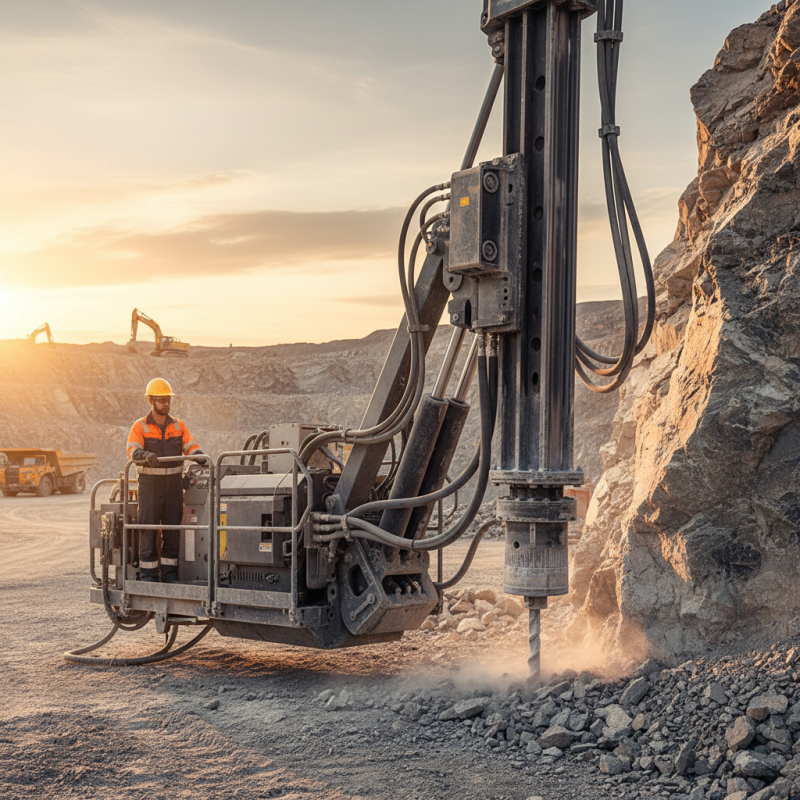
What is a Hydraulic Rock Drill? Overview of its Definition and Uses
A hydraulic rock drill is a powerful tool used in construction and mining. It utilizes pressurized fluid to create intense force for drilling into hard rock. These drills are essential for various applications, including tunneling, quarrying, and foundation work. According to a report by the Global Market Insights, the hydraulic rock drill market is anticipated to exceed $2 billion by 2027, driven by the growing demand for infrastructure development.
These drills operate by converting hydraulic energy into mechanical energy. The hydraulic fluid is channeled through hoses to the drill bit. This mechanism allows for high efficiency and deep penetration capabilities. Reports indicate that hydraulic rock drills can accomplish tasks much faster than traditional methods. However, users must consider maintenance costs and downtime issues, as improper handling can lead to costly repairs.
Safety is another concern in using hydraulic rock drills. Data from the Occupational Safety and Health Administration (OSHA) reflect that nearly 20% of accidents in construction involve powered hand tools. Proper training and precautions are vital. While these drills are efficient, they can also be dangerous if not used correctly. Reflection on safety protocols and regular training sessions is essential for optimal performance and worker safety.
Hydraulic Rock Drill Usage by Sector
Key Components of Hydraulic Rock Drills: Anatomy of the Machine
Hydraulic rock drills are essential tools in construction and mining. These machines rely on high-pressure hydraulic fluids to convert energy into mechanical power. Understanding their key components is crucial for both operators and engineers.
The heart of a hydraulic rock drill is its hydraulic system. This system consists of pumps, valves, and cylinders. The pump moves hydraulic fluid, generating pressure. The valves control fluid flow, directing it to specific areas. Finally, the cylinders convert hydraulic power into linear movement. This movement produces the force needed to penetrate rock. Each part must work cohesively to ensure efficiency and safety.
Another critical component is the drill bit. Made from durable materials, drill bits come in various shapes and sizes. Their design impacts drilling speed and precision. Regular inspection is necessary to avoid wear and tear. An inefficient drill bit can lead to delays and increased costs. Understanding these components helps in maintaining equipment and improving overall performance.
What is a Hydraulic Rock Drill and How Does It Work? - Key Components of Hydraulic Rock Drills: Anatomy of the Machine
| Component |
Function |
Material |
Common Sizes |
| Hydraulic Cylinder |
Converts hydraulic energy into mechanical force |
Steel |
Bore Diameter: 50-100 mm |
| Drill Bit |
Cuts through rock and other hard materials |
Tungsten Carbide |
Diameter: 32-60 mm |
| Hydraulic Pump |
Supplies hydraulic fluid under pressure |
Aluminum, Steel |
Flow Rate: 20-100 L/min |
| Control Valve |
Regulates hydraulic fluid flow to cylinders |
Brass, Steel |
Various sizes, typically 1-2 inches |
| Frame |
Supports and houses all machine components |
Welded Steel |
Standardized sizes, customizable |
Working Principle: How Hydraulic Power is Transformed into Drill Motion
Hydraulic rock drills are powerful tools used in construction and mining. They transform hydraulic energy into mechanical motion, allowing for efficient drilling. The working principle relies on high-pressure hydraulic fluid, which activates pistons connected to the drill bit. As fluid flows through, it creates rapid and controlled movements. This makes drilling faster and more effective compared to manual methods.
The mechanism is straightforward. Pressurized hydraulic fluid enters the drill, pushing the piston. This movement drives the drill bit into hard surfaces. The design ensures minimal vibration and noise, enhancing the operator's comfort. Adjustments can be made for different rock types, but frequent maintenance is required. It’s important to monitor the hydraulic system to prevent malfunctions.
**Tip:** Regularly check seals and hoses for leaks. This can save time and reduce costs.
Drilling may seem simple, but precision is key. Too much pressure can damage the drill bit or the rock. Less experienced operators might overlook small details. Understanding the hydraulic system and its components improves efficiency. Employing caution and attention to the environment will yield better results.
Applications of Hydraulic Rock Drills in Construction and Mining Industries
Hydraulic rock drills play a crucial role in construction and mining industries. These powerful tools are engineered to penetrate tough rock formations. They utilize high-pressure hydraulic fluid to create force, making drilling efficient and effective. According to a report by Market Research Future, the global hydraulic rock drill market is expected to reach $4 billion by 2025, driven by increasing demand for mining operations.
In construction, hydraulic rock drills are essential for tunnel excavation, road construction, and foundation work. They provide precision and speed, minimizing project completion times. Data suggests that using hydraulic drills improves productivity by up to 30% compared to traditional methods. In mining, these drills assist in ore extraction, enabling deeper and safer mining processes. This is especially important in a world where mineral demand is increasing.
While hydraulic drills offer many advantages, challenges persist. Operator training is critical. Improper use can lead to equipment damage or accidents. Regular maintenance is necessary, yet often neglected. Industry studies indicate that up to 25% of drilling downtime is due to equipment failure. Balancing efficiency with safety and upkeep is essential for maximizing the benefits of hydraulic rock drills.
Performance Metrics: Efficiency and Power Output of Hydraulic Rock Drills
Hydraulic rock drills are vital in construction and mining. They deliver high efficiency and impressive power output, making them essential for heavy-duty tasks. Industry reports indicate that top-tier hydraulic drills can achieve penetration rates of 1.0 to 2.5 meters per minute in hard rock. This efficiency is significantly higher than traditional methods, saving both time and labor costs.
Power output is another critical metric. Hydraulic drills typically operate at a power range of 20 to 110 kW, depending on the model. This capability allows them to tackle various materials with ease. According to recent studies, better power-to-weight ratios lead to faster production cycles. However, operators must be aware of the potential for over-pressurizing the system, which may reduce efficiency and cause wear.
Tip: Always maintain proper fluid levels to ensure optimal performance. Regular checks will help prevent excessive wear on components.
Emphasizing efficiency brings challenges. Manufacturers should aim for consistent performance while minimizing downtime. While advanced models can drill deeper and faster, they may require more maintenance. Balancing power and efficiency is non-trivial. Regular training for operators can bridge this gap, ensuring machines perform at their best.
FAQS
: Hydraulic rock drills transform hydraulic energy into mechanical motion for efficient drilling.
Pressurized hydraulic fluid activates pistons, creating rapid movements that drive the drill bit.
Regular maintenance prevents malfunctions and ensures optimal performance during use.
Excessive pressure can damage the drill bit and reduce overall efficiency.
Efficiency and power output are crucial metrics impacting drilling speed and effectiveness.
Understanding the hydraulic system and being attentive to details can improve drilling success.
They might overlook small details, which can affect drilling precision and efficiency.
Hydraulic drills usually operate at a power range between 20 to 110 kW.
Maintaining proper fluid levels is vital to prevent excessive wear and maintain efficiency.
Regular training for operators can help improve their skills and machine efficiency.
Conclusion
A Hydraulic Rock Drill is a powerful tool widely used in construction and mining industries for drilling into hard rock surfaces. This machine operates on the principle of hydraulic power, where fluid pressure is converted into mechanical force to create drilling motion. Key components of a hydraulic rock drill include the hydraulic pump, drill bit, and various control systems that work together to enhance efficiency and performance.
The applications of hydraulic rock drills are vast, ranging from tunnel excavation to mineral exploration. Their performance metrics, such as efficiency and power output, make them essential for tasks requiring precise and robust drilling capabilities. By utilizing hydraulic technology, these drills provide significant advantages in terms of speed and effectiveness in various geological conditions.

 KAT DRILLING